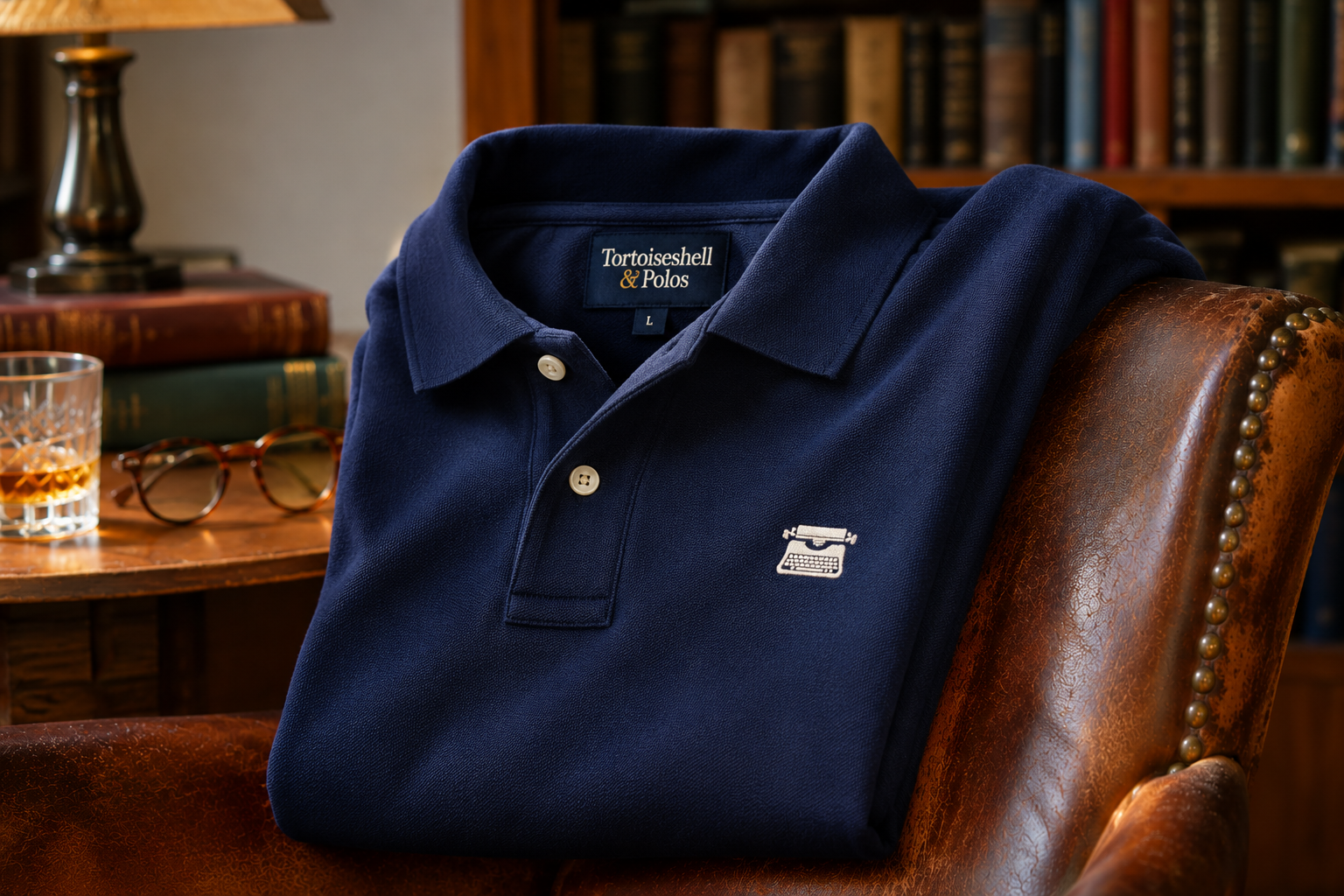
All Hail The Navy Blue Polo
My Heading
If you were to look in the second drawer of my dresser, you’d see a metric boatload of polo shirts from an array of brands—J. Crew, Criquet, Lacoste, Charles Tyrwhitt, Tommy Hilfiger, Greg Norman, and, of course, the OG, Ralph Lauren.
I’m talking about the humble polo shirt, specifically the navy blue polo shirt.
I probably have a dozen of them competing for time in the rotation. However, I must say, I’m partial to my RLs, and I’ll completely admit to getting sucked in by the Polo mystique despite having never set foot on an Ivy League campus, attended a polo match, or spent afternoons sailing with any regularity.
Regardless of my lack of blue-blood street cred, I think I have the authority to declare this: The navy blue polo is the ultimate shirt.
But before I dive into my argument, first a little history lesson.
From the Tennis Court to the Country Club
The modern polo shirt actually owes much of its popularity to a completely different sport—tennis.
René Lacoste, a successful French tennis player in the early 20th century, wanted to reconsider traditional tennis attire. At the time, players commonly wore long-sleeved white shirts, sometimes with ties, that were supposed to remain tucked throughout a match.
Lacoste wanted something that would allow him greater freedom of movement while still adhering to the hoity-toity traditions of tennis whites.
Borrowing from sporting shirts already in use, Lacoste's solution was a short-sleeved, breathable cotton-knit shirt with a longer tail in the back to help it remain tucked in, and a soft collar that could be popped to protect his neck from the hot sun.
He debuted his shirt at the 1926 U.S. National Championships, the precursor to today's U.S. Open. Known as "The Crocodile" for his tenacity on the court, Lacoste subsequently added the now-famous crocodile emblem to his tennis attire.
Sensing an opportunity, Lacoste partnered with André Gillier, a French garment manufacturer, and voilà! In 1933, the Lacoste tennis shirt became commercially available.
For many people, the garment is still known as the "tennis shirt." For instance, Jerry Seinfeld refers to his top as a tennis shirt in the infamous episode in which he fears he may have been violated by his dentist—played by Bryan Cranston—while under the gas.
Although polo players had worn collared sporting shirts before Lacoste's innovation, knitted, short-sleeved versions eventually became popular in polo as well, helping establish the name by which we know the garment today.
The polo shirt also found a home on golf courses, where it became associated with some of the sport's most recognizable personalities, including Arnold Palmer and President Dwight Eisenhower, an avid golfer himself.
Not bad for a shirt originally designed to make chasing a tennis ball a little more comfortable.
The Preppy Revolution
Although the polo shirt had been around for decades, its transformation into an American fashion staple accelerated in 1972, when Ralph Lauren introduced his now-iconic cotton-mesh polo shirt in a rainbow of colors, including navy blue.
The timing couldn't have been better.
By the late 1970s and early 1980s, the polo shirt had become one of the defining garments of the preppy look, alongside penny loafers, Oxford shirts, cable-knit sweaters, and khakis.
Two brands in particular dominated the conversation: Ralph Lauren and Lacoste, the latter marketed in the United States under the Izod Lacoste name.
The Izod-Lacoste partnership began in 1952 through American clothing executive Vincent dePaul Draddy, who had acquired the rights to the Izod name from a British tailoring business. The arrangement lasted until 1993, when the two brands went their separate ways.
During its heyday in the 1970s and 1980s, the little crocodile was practically inescapable. Around the Southeast, those shirts were often paired with durable, rugged Duck Head khakis, creating a look that was equally appropriate for a college fraternity party or Sunday lunch with the grandparents.
The polo also helped usher in the business-casual revolution of the 1990s, when companies began loosening their dress codes and allowing employees to replace suits and ties with collared shirts and chinos.
Somewhere along the way, a shirt designed for a French tennis champion became the unofficial uniform of American leisure. From country clubs to college campuses, office cubicles to backyard cookouts, the polo had conquered just about every corner of American life.
And while the shirt comes in virtually every color imaginable, one stands above the rest.
In Defense of Navy Blue
Since Lacoste and Izod parted ways in the early 1990s, Ralph Lauren has remained one of the most recognizable names in polo shirts and, in my humble opinion, the gold standard.
The classic cotton knit is my definite go-to. However, while there are plenty of tastemakers who insist that traditional cotton piqué is the only material worth wearing, I will say that some of the newer, lighter-weight performance fabrics are a godsend during a hot and humid Alabama summer.
I'm not going to suffer heatstroke just to satisfy some menswear purist in New York.
And while you can find polos in almost any color under the sun, navy blue is the unquestioned champion.
It's understated without being boring, sophisticated without being pretentious, and versatile enough to work with practically anything in a man's wardrobe. It also has the distinct advantage of looking good on just about everybody.
You can't go wrong with a navy blue polo and a pair of chinos at the office, untucked with worn jeans at a Mexican restaurant with your family, or poolside with a classic pair of Bermuda shorts, sockless loafers, and a cold bottle of Stella Artois in your hand.
The navy blue polo looks great dressed up with a blazer, strolling the beach barefoot in a weathered canvas ball cap as the sun sets over the Gulf of America, or waiting for a table at a crowded bar with a group of college buddies, sipping Kentucky bourbon and telling a joke that would get you called into HR in a heartbeat.
Try pulling off that kind of versatility with a bright orange golf shirt.
Heck, I even wore a navy blue polo with a pair of Duck Head khakis to my daughter's college graduation a couple of years ago, and I was easily the best-dressed guy in the joint.
At least that's how I remember it.
The Greatest Shirt Ever Made
Fashion trends come and go. Lapels get wider and narrower, jeans get baggier and tighter, and every few years some designer decides that men should start wearing something completely ridiculous.
Through it all, the polo shirt endures.
And the navy blue polo, in particular, has never needed to reinvent itself. It doesn't scream for attention, doesn't require a complicated wardrobe to pull off, and doesn't care whether you're wearing a Rolex or a Timex.
It simply works.
There are probably a dozen navy blue polos in my dresser right now. Some are faded, some are practically new, and a few probably should have been retired years ago. Yet every time I see another one that catches my eye, I find myself thinking there's always room for one more.
So, after a century of tennis matches, country clubs, preppy college campuses, corporate Casual Fridays, and countless afternoons spent doing absolutely nothing of consequence, I believe the verdict is in.
All hail the navy blue polo!
Коментувати